

Search the site

Rodin and Monet were bound by a lifelong friendship and reciprocal admiration. While they were true contemporaries, born within two days of one another in November 1840, it is hard to pinpoint when they actually met. They were almost certainly introduced by mutual friends like writers and critics Octave Mirbeau and Gustave Geoffroy, or the art dealer Paul Durand-Ruel. On his return from Belle-Île in 1886, Monet is known to have started attending dinners held by the “Bons Cosaques”, a group of artists and men of letters gathered together by Octave Mirbeau. Rodin also frequented these literary and artistic dinners that contributed to the intellectual effervescence of the period and challenged Academicism. By the time of the exhibition held at the Galerie Georges Petit in 1889, the four protagonists (Rodin, Monet, Mirbeau and Geffroy) definitely knew and already respected each other. On a visit to the Mirbeau family, near Auray (Brittany), in 1887, Rodin saw the ocean for the first time and is said to have exclaimed: “It’s a Monet!” To Mirbeau’s way of thinking, Rodin and Monet had embarked on the same artistic adventure and were destined to be equally successful. In November 1886, he wrote to Rodin about the paintings that Monet was going to exhibit at Petit’s gallery the following year: “He works hard and, in my opinion, he has done great things: it will be a new facet of his talent; a formidable, awe-inspiring Monet, of whom we were unaware… Our friend Monet is a heroic man of courage, and if anyone deserves to succeed alongside you, it’s him.”
Journeys divided by everything
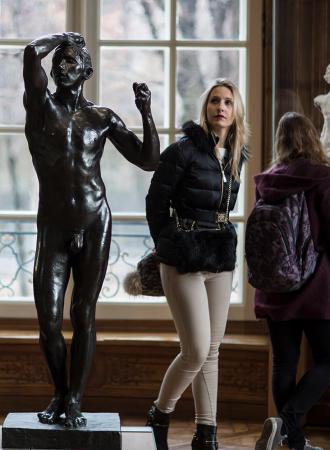
Although both embodied a revolutionary turning point in their respective arts, it is hard to imagine artistic paths more different than those of Rodin and Monet. Rodin, who left Paris for Brussels for several years at the beginning of his career, was slow to assert himself: The Man with the Broken Nose and Young Girl with a Hat date from the mid-1860s, while The Age of Bronze, and the scandal that finally brought him recognition, date from 1877. By that time, Monet was already an established artist. His meteoric career truly began in 1865 with Déjeuner sur l’herbe, followed the next year by Women in the Garden; in 1874, with Impression, Sunrise, he signed the birth certificate of the Impressionist movement.
In the 1880s, supported by Durand-Ruel, Monet’s work was purchased exclusively by private collectors. For Rodin, this period marked the moment of official recognition. The Age of Bronze was finally acquired by the French State in 1880, which also commissioned The Gates of Hell. Other major commissions followed: the Bust of Victor Hugo in 1883 and the Monument to the Burghers of Calais in 1885. In 1887, Rodin was made a Knight of the Legion of Honour. Now regarded as an official artist, he served on the jury of the 1889 Exposition Universelle. He also began to receive international recognition, which would continue to grow: in February 1889, while Monet, along with Seurat, Pissarro, and Gauguin, was invited to exhibit with the Group of Twenty in Brussels, Rodin was appointed a full member.
Monet’s situation stands in sharp contrast to Rodin’s success. Although the painter continued to produce masterpieces, he was constantly plagued by financial difficulties and faced public incomprehension as well as the sarcasm of critics.
Around the galerie Georges Petit
Since the opening of the Galerie Georges Petit in 1882, Rodin and Monet had regularly exhibited there in group shows. Distinguished by its generous proportions and particularly luxurious fittings, the Petit Gallery stood apart from those of other art dealers; Petit also regularly organized exhibitions of an international scope. In 1886, as the eighth Impressionist exhibition announced the definitive dissolution of the group, works by Monet and Renoir were shown at the Petit Gallery alongside sculptures by Rodin. The three artists were reunited again in 1887 for the Sixth International Exhibition, together with Raffaelli, Pissarro, Sisley, Morisot, and Whistler.
The ground was thus prepared for what would become, alongside the Exposition Universelle, the major artistic event of the summer of 1889. Initiated during the previous year, the project was to bring together, in a single exhibition at the Petit Gallery, works by Monet, Rodin, Renoir, and Whistler. When Petit declined, however, another exhibition was conceived instead, “but just you and me,” Monet wrote to Rodin in February 1889. The exhibition was to be accompanied by a catalogue, with prefaces by Mirbeau (for Monet) and Geoffroy (for Rodin). The stakes were high for the painter: while the invitation extended to the sculptor was certainly an expression of genuine admiration, it also represented the prospect of long-awaited public recognition. Comparable in ambition to the exhibition Rodin would organize in 1900 at the Pavillon de l’Alma, the show was in fact almost a retrospective of Monet’s work, featuring no fewer than 145 paintings dating from 1864 to 1889. While Monet was fully committed to the project, Rodin approached it with greater detachment. Preoccupied with his work on The Gates of Hell, he wrote to Geoffroy: “I will only be able to exhibit very little, almost nothing; my name will be there with Monet’s—that is all.” In the end, however, the public would discover no fewer than thirty-six sculptures alongside Monet’s paintings.
Until the very last moment, the exhibition nearly failed to take place. On 20 June, the eve of the opening, Monet and Petit sent Rodin a telegram urging him to come that very evening to deliver his remaining works and install them. Rodin complied, but the following morning Monet discovered that the newly installed pieces—particularly The Burghers of Calais—obscured an entire section of his display. He confided his disappointment in a letter to Petit written that same day: “I came to the gallery this morning and was able to confirm what I had feared: my back panel, the best part of my exhibition, has been completely lost since the placement of Rodin’s group. The damage is done… it is distressing for me. If Rodin had understood that, exhibiting together, we needed to agree on the placement—if he had taken me into account and given a little consideration to my works—it would have been very easy to arrive at a fine arrangement without harming one another. In short, I left the gallery utterly dejected, resolved to disengage myself from my exhibition and not to appear there. I struggled to contain myself yesterday when I saw Rodin’s strange behavior. I now aspire to only one thing: to take the road to Giverny and find peace there…”
Edmond de Goncourt reports that Rodin reacted violently to Monet’s dissatisfaction:
“There were, it seems, terrible scenes in which the gentle Rodin, suddenly revealing a Rodin unknown to his friends, cried out: ‘I don’t give a damn about Monet, I don’t give a damn about anyone—I only care about myself!’”
Despite these tensions, which were soon resolved, the exhibition was a great success with both the public and critics. Monet and Rodin then embodied, in Mirbeau’s words, “most gloriously and most definitively, these two arts: painting and sculpture.”
SHARED CAUSES
Although wounded by Rodin’s attitude during the preparation of their joint exhibition, Monet retained his full admiration for him. The two men continued to meet from time to time, despite the distance created by the painter’s move to Giverny, to the property he acquired in 1890, and their regular correspondence bears witness to a steadfast friendship that lasted until the sculptor’s death in 1917. They also came together around shared causes, supporting one another whenever possible and sharing circles of friends.
Thus, at the end of 1889, buoyed by his recent success, Monet initiated efforts to bring Manet’s Olympia into the collections of the Louvre and sought Rodin’s support among those he believed would favor this act of consecration. The sculptor replied at once: “My dear Monet, put me down for 25 francs. It is to have my name included. I am going through a financial crisis that does not allow me to give more. I congratulate you for having, through your efforts, given a painting by Manet to the Louvre. With friendship, Rodin.”
In 1892, when the painter Jules Breton, who had been commissioned to execute a large landscape for the Paris City Hall, resigned from the project, Rodin—then a member of the building’s decoration committee—proposed Monet as his replacement. Unfortunately for Monet, the vote awarded the commission to the young academic painter Pierre Lagarde.
Finally, in 1894, it was thanks to Monet that Rodin and Cézanne, another major figure of modernity, met at Giverny, in the presence of Mirbeau, Clemenceau, and Geoffroy. The latter recounts words spoken by Cézanne that testify to the aura Rodin then enjoyed, even in the eyes of the fiercely independent master from Aix: “He is not proud, Monsieur Rodin—he shook my hand! A decorated man!!!”
A LASTING FRIENDSHIP
In 1897, unable to attend the opening of his exhibition at the Société Nationale des Beaux-Arts, Monet sent Rodin a friendly message. Moved by this gesture of friendship, the sculptor sent him a drawing entitled Salomé, the whereabouts of which are now unknown. That same year saw the publication of the first book devoted to Rodin’s drawings, with a preface by Mirbeau. To Monet—who had received a copy and written to express his friendship and admiration—Rodin replied: “Your letter delighted me, for you know that, preoccupied as we both are with our pursuit of nature, expressions of friendship often suffer; yet the same feeling of fraternity, the same love of art, has made us friends forever, and I am therefore happy to receive your letter. (…) It is the same admiration I have always had for the artist who helped me understand light, clouds, the sea, the cathedrals I already loved so deeply, but whose beauty, awakened at dawn through your interpretation, moved me so profoundly.”
The following year, Monet wrote to Rodin once again to renew his support. The sculptor was then under heavy attack from critics over his Balzac, whose plaster version was shown for the first time at the Salon. Monet added his signature to those of artists and intellectuals (Signac, Carrière, Toulouse-Lautrec, Debussy, Anatole France, Mirbeau, Jules Renard, Courteline, Henri Becque, Jean Moréas, Lugné-Poe, Clemenceau, Bourdelle, Maillol…) in a public letter of protest expressing “the hope that, in a noble and refined country such as France, Rodin will continue to be the object of the public’s consideration and respect, to which his high integrity and admirable career entitle him.”
Once again moved by this demonstration of friendship, Rodin wrote to thank Monet, identifying his own struggle with that of the Impressionists a few years earlier: “Your appraisal is one of those that strongly sustain me; I have taken a broadside similar to the one you once endured, when it was fashionable to laugh at the invention you had of putting air into landscapes.”
In 1900, Monet was among the contributors to the catalogue of Rodin’s works published on the occasion of the Pavillon de l’Alma exhibition. The short text he sent from Giverny expresses, along with the painter’s modesty, his friendship and admiration for Rodin: “You ask me to tell you, in a few lines, what I think of Rodin. You know what I think of him, but to say it properly I would need a talent I do not possess; writing is not my profession. What I do wish to tell you, however, is my great admiration for this man, unique in our time and great among the greatest. The exhibition of his work will be an event. Its success is certain and will be the definitive consecration of a fine artist.”
When, in 1904, a public subscription was launched to offer an enlarged bronze version of The Thinker to the City of Paris, which at that time possessed no public monument by Rodin, Monet was eager to contribute, giving two hundred francs, a considerable sum for an artist of relatively modest means.
It was again thanks to Monet that an exhibition of Rodin’s drawings was organized at the gallery of Durand-Ruel, the painter’s dealer and champion, in 1907. Finally, in May 1917, a few months before Rodin’s death, Monet, in anticipation of the creation of the museum that would be devoted to his friend’s work, offered his assistance in helping to catalogue the sculptor’s drawings.
TWO ALLIED COLLECTIONS
The friendship between the two artists left tangible traces in their respective collections. In 1888, an exchange of works took place: Monet gave Rodin a painting entitled Belle-Île, from a group of thirty-nine canvases painted directly from nature in 1886 during his stay at Belle-Île-en-Mer, and shown at the Sixth International Exhibition at the Georges Petit Gallery in 1887. Kept by Rodin on the second floor of the Villa des Brillants (as noted by Maurice Guillemot, “Au Val Meudon,” Le Journal, 17 August 1898, cited p. 36 of Monet–Rodin, exhibition catalogue, 1989), the work remains today in the museum’s collections (inv. P7329).
In return, Rodin offered Monet a choice between two works, most likely She Who Was the Fair Washerwoman (Celle qui fut la belle Heaulmière) and a bronze of Young Mother in the Grotto (1885; the plaster, inv. S.1196; the bronze was later bequeathed by Michel Monet to the Musée Marmottan [Marmottan, inv. MM.5180]). Having received the bronze, Monet wrote to the sculptor to thank him: “My dear Rodin, let me tell you how happy I am with the beautiful bronze you sent me. I have placed it in the studio so that I may see it constantly. I returned utterly enchanted by your Gates and by everything I saw at your place. Thank you again. With friendship.”
It is difficult to date precisely the other exchanges that must have taken place between Monet and Rodin, and literary sources are sometimes confusing. Thus Geoffroy, in Claude Monet, His Life, His Work, mentions the presence of a marble by Rodin, Woman and Child, in the studio-salon at Giverny, and, in Monet’s bedroom, the two works to which the painter was most attached—two bronzes by Rodin. There is likely some confusion here between, on the one hand, the bronze (and not the marble) of Young Mother in the Grotto, and, on the other, the plaster of The Minotaur, which Monet did indeed own (also known as Faun and Nymph, or Jupiter as a Bull; Marmottan, bequest of M. Monet, inv. MM.5127).
Rodin’s collection also includes a drawing by Monet (see Young Man Wearing a Cap, inv. D.7694), executed during the artist’s youth, probably in 1857, shortly before he left Le Havre for Paris. The drawing is close in spirit to the caricatures Monet sometimes exhibited at the time alongside the paintings of Boudin, which he managed to sell with some success. The circumstances under which this drawing entered Rodin’s collection, however, remain unexplained.
Two DONATIONS and the Birth of the Idea of a Museum of Modern Art
In 1916, Rodin’s donation of his works to the French State inspired Monet, who in turn decided in 1920 to donate his series of Nymphéas (the donation becoming effective in 1922). The paintings were installed at the Orangerie des Tuileries in May 1927, a few months after Monet’s death in 1926.
Before this location was chosen, other possibilities had been considered. An initial plan proposed the construction of a pavilion, designed by Bonnier, on the site of the Musée Rodin—opened to the public in 1919—in the eastern part of the estate (where The Gates of Hell now stand, at a time when the work had not yet been cast). As the project expanded, a more ambitious and complex building was envisaged, based on plans by Girault, encircling the Hôtel Biron and bringing together the Musée Rodin and a “National Museum of Contemporary Arts.”
This ensemble was never realized, but it may be regarded as a precursor of the Musée National d’Art Moderne. And it was indeed the mutual esteem and friendship of two artists embodying two distinct paths of modernity—Rodin, through fragmentation, reproduction, and assemblage; Monet, whose pictorial investigations opened the way to American abstraction—that were, at least in part, at the origin of its creation.